
Why School-Based OTs, PTs, and SLPs Need to Understand MTSS
Updated: Sep 16

If you are an occupational therapy practitioner, physical therapist, or speech-language pathologist working in schools, you have probably heard the term MTSS.
You may attend MTSS meetings. You may be asked for strategies. You may receive referrals after a student has moved through several levels of intervention.
But do school-based therapists really need to understand MTSS?
Yes. And our role may be more important than we realize.
Multi-Tiered Systems of Support (MTSS) is not simply an intervention process that happens before special education. It is a school-wide framework for identifying student needs, providing increasingly individualized support, and using data to guide decisions.
For school-based therapists, understanding MTSS creates an important opportunity: we can contribute our expertise before participation challenges become significant enough to require individualized services.
What Is MTSS?
MTSS stands for Multi-Tiered System of Supports.
Although implementation varies across schools and districts, MTSS generally organizes support into three levels:
Tier 1: Universal Supports. Strategies, instruction, environments, and routines designed to support all students.
Tier 2: Targeted Supports. Additional support for students who need more than universal strategies to participate successfully.
Tier 3: Intensive, Individualized Supports. More individualized intervention based on a student's specific needs and response to previous supports.
The goal is not simply to move students from one tier to another.
The goal is to identify barriers early and provide the right support at the right level.
And that is exactly where therapists have something important to contribute.
Why Therapists Belong in the MTSS Conversation
School-based OTs, PTs, and SLPs bring perspectives that may not be represented when a team looks primarily at academic performance or observable behavior.
We notice things like:
sensory and environmental demands
postural and motor demands
communication barriers
regulation and co-regulation
interoceptive awareness
executive function demands
task complexity
environmental accessibility
participation across routines
the interaction between the student, task, and environment
Consider a student who regularly avoids independent writing. One interpretation might be: The student is refusing to complete work.
But a therapist may ask different questions.
Is maintaining the seated position effortful?
Is the student struggling to organize materials and ideas?
Are the motor demands of writing consuming significant cognitive resources?
Is the student unsure how to begin?
Is the classroom environment contributing to overload?
Can the student recognize when they need support?
Does participation improve when the task, environment, movement demands, or adult support changes?
The questions can completely change the intervention.
Behavior May Be the Starting Clue, Not the Starting Point
Many students enter support systems because of something adults can see:
incomplete work
difficulty transitioning
emotional escalation
inattention
disorganization
task avoidance
shutdown
impulsivity
inconsistent participation
The observations matter. But they do not necessarily tell us why the student is struggling.
Within the From Roots to Fruit™ Integrated Interoception Tree Model, I describe observable behavior and participation as the fruit of a much larger system.

Behavior is the fruit, not the root.
When we only respond to the fruit, we risk choosing interventions before we understand the conditions contributing to it. A behavior chart might increase motivation but do little for a child who cannot initiate a complex task. Repeated verbal reminders may add cognitive demand for a student whose working memory is already overloaded. A visual schedule may be useful, but it may not address a transition that feels physically or emotionally overwhelming. A movement break may help one student and disrupt another. The question is not, “What strategy should we try?” A better question is: “What is influencing this student's access to participation?”
MTSS Gives Therapists a Chance to Think Upstream
Traditionally, therapy involvement in schools has often centered on students who already receive special education services. MTSS creates opportunities to contribute earlier. Instead of waiting until participation has significantly broken down, therapists can help teams examine classroom environments, routines, task demands, communication supports, movement opportunities, sensory conditions, and executive function demands.
That might mean helping a teacher develop more accessible classroom routines. It might mean identifying why transitions are difficult for a group of students.
It might mean suggesting environmental changes before assuming a student needs an individualized intervention. Or it might mean recognizing that a student's difficulties warrant more individualized assessment and support. This is not about turning every classroom challenge into a therapy referral.
In many ways, it is the opposite. Therapists can help schools build environments and systems that support participation from the beginning.
MTSS Is More Than Moving Through Tiers
One of the easiest mistakes to make with MTSS is thinking of the tiers as a staircase:
Tier 1 didn't work → move to Tier 2.
Tier 2 didn't work → move to Tier 3.
But increasing the intensity of an intervention does not necessarily make it the right intervention. If we have misunderstood the barrier, we may simply provide more of a support that was never addressing the actual problem.
Before escalating intervention, teams can ask:
What is making participation difficult?
When does the student participate successfully?
What changes across environments or routines?
What strengths can we build upon?
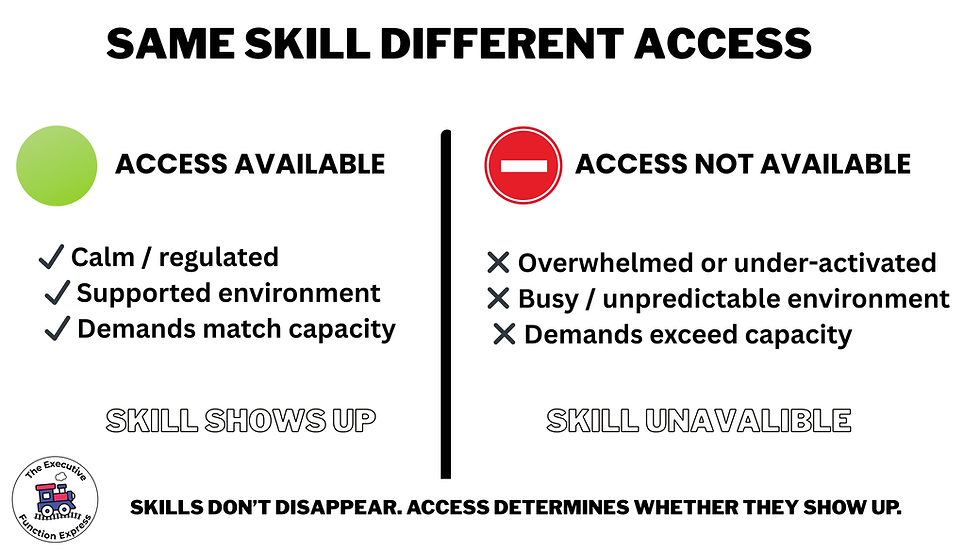
Is this primarily a skill barrier or an access barrier?
Are task demands exceeding the student's current capacity?
What happens when we change the environment?
What support increases successful participation?
This is clinical reasoning, and therapists are trained to do it.
Bringing a Body-First Lens to MTSS
There is another perspective therapists can bring to MTSS conversations that I believe is particularly important: The body influences access to learning. Executive function, communication, movement, emotional regulation, attention, and participation do not operate independently of physiological state. A student may possess a skill and still have difficulty accessing it under certain conditions. That is why performance can look so different from one classroom to another, or even from one part of the day to another.
When participation changes, we can consider:
Regulation: Is the student's current state supporting participation?
Interoception: Can the student notice and make sense of internal signals related to stress, fatigue, movement, discomfort, hunger, or emotional state?
Executive Function: Are planning, initiation, working memory, flexibility, organization, and self-monitoring available under the current demands?
Sensory Environment: Is the environment supporting access or adding unnecessary
load?
Movement and Postural Demands: How much physical effort does the task require?
Communication: Can the student understand expectations and communicate needs, uncertainty, discomfort, or requests for support?
These considerations do not excuse behavior or eliminate expectations.
They help us make better intervention decisions.
From “What Is Wrong?” to “What Would Support Access?”
This may be one of the most valuable contributions therapists can make to MTSS. When a student struggles, we can help teams remain curious.
Instead of immediately asking:
How do we get this student to comply?
We can ask:
What is making participation difficult?
Instead of:
Why won't they start?
We can ask:
What might be making task initiation difficult right now?
Instead of:
We've already given them supports. Why aren't they working?
We can ask:
Do these supports actually match the barrier?
That shift matters. Because effective MTSS is not about accumulating interventions.
It is about improving the match between student needs, environmental conditions, task demands, and support.
School Therapists Need a Seat at the MTSS Table
OTs, PTs, and SLPs have expertise that extends far beyond providing individual therapy.
We understand participation.
We understand how environments influence performance.
We understand that the same student can demonstrate very different abilities under different conditions.
And we are trained to analyze the interaction between the person, the task, and the environment.
Those perspectives belong in MTSS. When therapists understand the MTSS framework, we can move beyond waiting for referrals and become collaborators in creating more accessible school environments for all students. That doesn't diminish our role as therapists. It expands it.
Want to Take This Further?
I created the MTSS Access Toolkit™: Interoception, Regulation, & Executive Function Support for Schools to help school professionals apply this type of reasoning within Tier 1, Tier 2, and Tier 3 supports.

The toolkit brings together body-first MTSS principles, interoception, regulation, executive function access, environmental supports, transitions, task initiation, co-regulation, case examples, and practical implementation tools. It is designed to help teams move beyond: “What intervention should we try next?” and toward: “What does this student need in order to access participation?”
Individual and organizational licenses are available.
Ready to bring an access-based lens to your MTSS process?
Final Thought
School-based therapists do not need to become MTSS coordinators. But we do need to understand the system in which our students receive support. Because when OTs, PTs, and SLPs bring our knowledge of the body, communication, movement, regulation, environment, executive function, and participation into MTSS, we can help teams intervene earlier and more precisely.
The goal isn't simply more support. It's better-matched support that increases access to meaningful participation.
Looking for a program to help with EF treatment ideas and planning? How about a program that fits your busy schedule that gives you in instant printable treatment plan with observation ideas, and SMART goals?


Dr. Cara Koscinski, OTD, MOT, OTR/L, CAS, is a seasoned pediatric occupational therapist, certified autism specialist, author of seven books, and founder of the Executive Function Institute. Known for her practical, strengths-based approach to neurodiversity, she specializes in helping children build executive function through sensory-aware, visual, and body-based strategies. Creator of The Executive Function Express program and a frequent speaker at national conferences, Dr. Koscinski brings warmth, clarity, and decades of clinical expertise to every tool she creates.

Comments