
Why Skills Don’t Always Show Up: Understanding Access in Children
Updated: May 9
A child completes a task one day… and struggles with the same task the next.
They follow directions in one setting… and seem unable to in another.
This pattern is often described as inconsistency. It can be confusing for caregivers, educators, and clinicians alike.
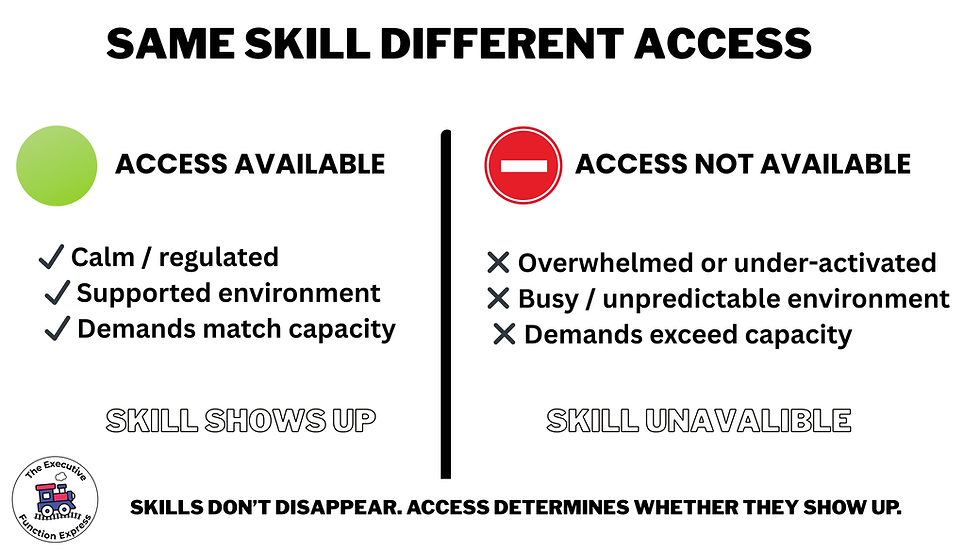
But this is not a loss of skill. It is a change in access.
What Is Access?
Access refers to the moment-to-moment availability of the body and brain systems needed for thinking, regulating, and acting.
A child may have a skill, but that does not mean they can use it at every moment.
Access is not fixed. It changes based on:
internal state
environment
sensory demands
level of support available
When access is available, skills show up. When access is limited, they do not.
A Real-Life Example
A child may be able to write a complete sentence during a quiet, structured therapy session.
The same child may struggle to begin writing in a busy classroom.
The skill has not disappeared.
Access to the skill has changed.
In the classroom, there may be:
increased noise
more complex demands
less individual support
The factors can reduce access, even when the child knows exactly what to do.
Why This Matters
When we focus only on whether a child can perform a skill, we risk misunderstanding what is actually happening.
A child may be seen as:
unmotivated
oppositional
inconsistent
In reality, the child may not have access to the systems required to perform the task in that moment.
This distinction matters because it changes everything:
how we interpret behavior
how we set expectations
how we provide support
Instead of asking, “Why aren’t they doing it?” We begin asking, “Is access available right now?”
From Roots to Fruit
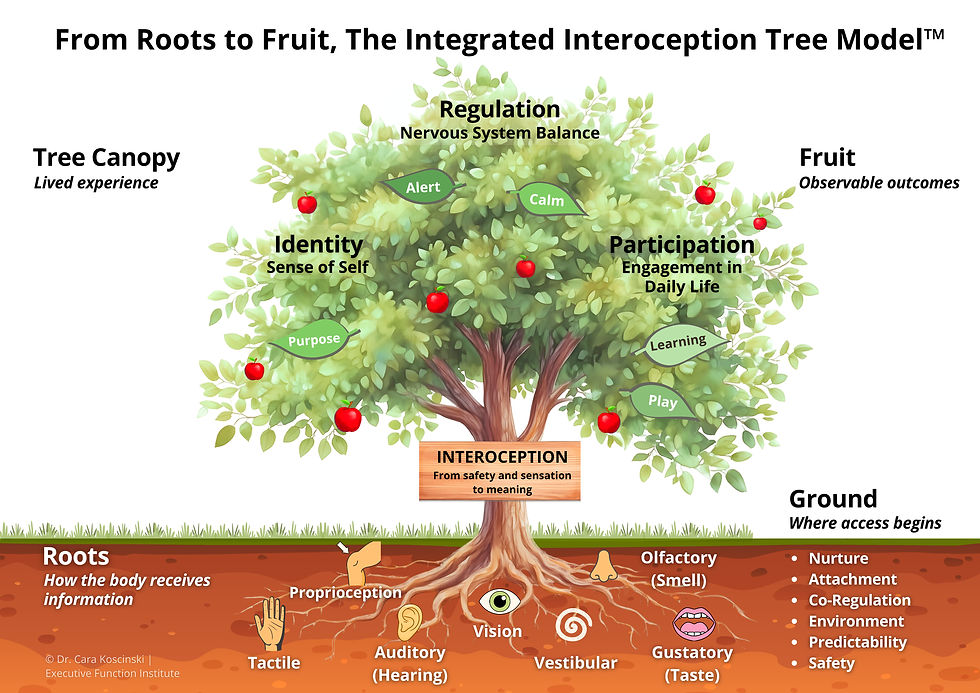
The From Roots to Fruit; Integrated Interoception Tree Model™ provides a clear way to understand this.
Ground → safety, relationships, predictability
Roots → sensory and regulatory foundations that build access
Trunk (Interoception) → integrates internal signals
Canopy → where executive function and participation emerge
Fruit → what we see (behavior and performance)
When access is not supported in the roots and trunk, the canopy cannot function effectively.
Behavior (the fruit) reflects what is visible, but not what is available internally.
Shifting the Lens
This shift moves us away from a behavior-first approach and toward a capacity-based understanding.
Instead of focusing only on performance, we begin to consider:
What is the child’s current state?
What demands are present?
What supports are available?
What conditions may be limiting access?
This perspective allows us to respond with greater clarity and effectiveness.
Reflection for Practice
The next time a skill does not show up, pause and consider:
Is the skill truly absent, or is access limited?
What has changed in the environment?
What is the child’s current level of regulation?
What support might increase access in this moment?
The questions shift the focus from correction to understanding.
Moving Forward
Skills do not disappear. Access does.
When we shift our attention to building access through regulation, environment, and support, we create the conditions that allow skills to emerge consistently.
This is where meaningful change begins.
🌳 From Roots to Fruit™ Building access first so children can think, regulate, and participate with greater success.

When the ground is supported, the whole tree can grow.

Dr. Cara Koscinski, OTD, MOT, OTR/L, CAS, is a seasoned pediatric occupational therapist, certified autism specialist, author of seven books, and founder of the Executive Function Institute. Known for her practical, strengths-based approach to neurodiversity, she specializes in helping children build executive function through sensory-aware, visual, and body-based strategies. Creator of The Executive Function Express program and a frequent speaker at national conferences, Dr. Koscinski brings warmth, clarity, and decades of clinical expertise to every tool she creates.

Comments