
Before the School Year Begins: Looking Beyond Behavior to Support Executive Function Access
Updated: Jul 21

As another school year begins, therapy schedules fill, classrooms come to life, and clinicians begin meeting new students while reconnecting with familiar ones. It is an exciting season filled with fresh opportunities, but it is also a time when first impressions can quickly become lasting assumptions.
Within the first few weeks of school, we often hear comments such as
"He won't get started."
"She never finishes her work."
"They're capable; they just aren't trying."
"He did it yesterday, so I know he can do it today."
The observations describe what we see, but they don't explain why we're seeing it. As clinicians, educators, and related service providers, one of the most powerful shifts we can make is replacing judgment with curiosity.
Instead of asking:
"Why won't this child do it?"
try asking:
"What might be making this difficult today?"
That single question has transformed my own clinical reasoning over nearly three decades of pediatric practice.
Executive function challenges are real.
But understanding executive function requires more than measuring skills alone.
Executive function is often described as a collection of skills such as planning, organization, working memory, flexible thinking, self-monitoring, emotional regulation, and task initiation.
Those skills matter.
But in everyday clinical practice, knowing what executive function is doesn't always explain why a child can access those skills one moment and seem unable to use them the next.
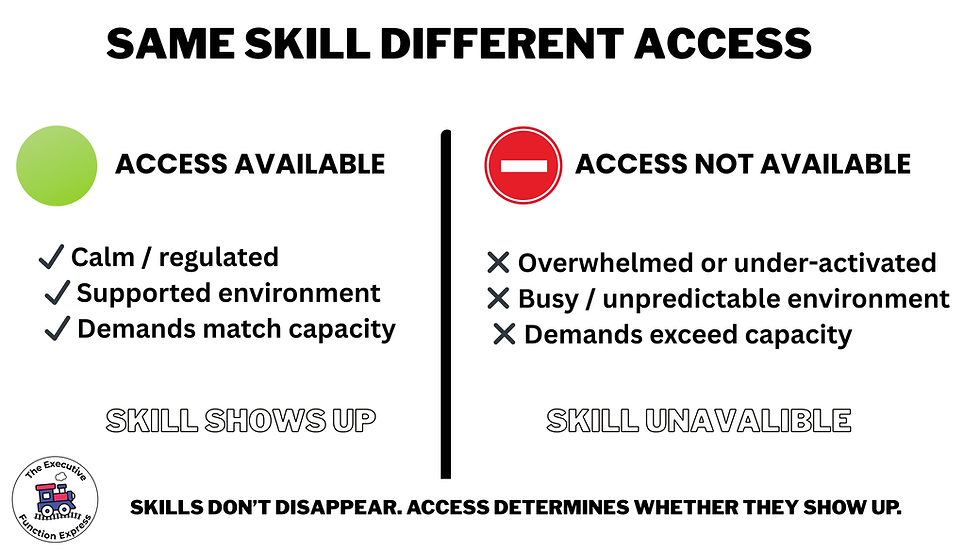
Children don't access executive function in isolation. The interaction between the child, their body, the environment, and the demands placed upon them constantly influence executive function. A child may independently organize materials during occupational therapy but struggle to find a single worksheet in a busy classroom.
Another may enthusiastically plan an elaborate LEGO structure but freeze when asked to begin a writing assignment. A student may appear inattentive late in the afternoon after spending the entire day working hard to regulate sensory input, navigate social expectations, and manage increasing cognitive demands.
The question is often not:
"Can this child do it?"
The better question is:
"Can this child access these skills right now?"
Looking Beneath the Surface
Executive function access changes throughout the day.
Many factors influence participation, including
Regulation
Interoceptive awareness
Sensory processing
Environmental demands
Relationships
Fatigue
Stress
Cognitive load
Demand-capacity match
When we look beneath observable behavior, our clinical reasoning changes.
Instead of documenting isolated behaviors, we recognize patterns.
Instead of focusing only on breakdowns, we become curious about moments of success.
Successful moments often provide our greatest clinical clues.
Ask yourself:
When is participation easiest?
What changed?
Who was present?
What support was available?
How demanding was the activity?
How regulated did the child appear?
What strengths became visible?
The questions frequently tell us more than a checklist of behaviors ever could.
Observe Before You Interpret
One of the easiest traps to fall into is assuming that inconsistent performance reflects inconsistent effort. It doesn't. Children whose executive function access changes may appear highly organized in one setting and overwhelmed in another.
They may complete a complex activity independently one day and need significant support the next. Rather than interpreting these differences as motivation or compliance, consider them valuable information.
Performance variability often tells us that something in the child's internal state or external environment has changed. When we observe before we interpret, we gather better information. And better information leads to better intervention planning.
A Different Way to Begin the School Year
As you begin this school year, challenge yourself to choose one student who seems difficult to understand.
For one week, simply observe. Notice
When participation comes easily.
When executive function appears most accessible.
What support seems to help?
Which environments encourage success?
Which demands increase difficulty?
Look just as carefully at strengths as you do at challenges. We might not find the answers we're searching for in moments of participation breakdown. They're revealed in the moments when participation becomes possible.
Download the FREE Back-to-School Clinical Toolkit
To help you apply these ideas immediately, I've created a free Back-to-School Clinical Toolkit: A Body-First Guide to Supporting Participation, Regulation, and Executive Function.
Inside the free 12-page Clinical Toolkit™, you'll find:
✅ Executive function observation guide
✅ Everyday behaviors linked to EF skills
✅ Strengths-based documentation examples
✅ Body-first support strategies
✅ Back-to-school planning tips
✅ Participation-focused clinical reasoning
✅ Neurodiversity-affirming language
✅ Practical intervention ideas

🚆 What's New at EFI
This month also marks an exciting milestone for the Executive Function Institute with the launch of the Executive Function Express Access Profiler (EFX-AP™).
The EFX-AP™ is a body-first, participation-focused assessment designed to help clinicians look beyond executive function skills alone and identify the factors that influence executive function access, including regulation, interoception, environmental fit, and demand-capacity match.
The goal isn't simply to identify areas of difficulty, but to help answer the most important clinical question: "What should I do next?"
Final Thoughts
Every school year offers us a fresh opportunity; not just to support children, but to refine the questions we ask as clinicians. When we replace assumptions with curiosity, we begin to see executive function differently.
We stop asking, "Why won't they?"
And instead ask, "What might this child need to access success today?"
Sometimes that single shift changes everything.

Dr. Cara Koscinski, OTD, MOT, OTR/L, CAS, is a seasoned pediatric occupational therapist, certified autism specialist, author of seven books, and founder of the Executive Function Institute. Known for her practical, strengths-based approach to neurodiversity, she specializes in helping children build executive function through sensory-aware, visual, and body-based strategies. Creator of The Executive Function Express program and a frequent speaker at national conferences, Dr. Koscinski brings warmth, clarity, and decades of clinical expertise to every tool she creates.


Comments