
What Is Inhibition and Why It Matters for Executive Function in Children
Updated: Dec 1, 2025

🚦 What Is Inhibition and Why It Matters for Executive Function in Children
🕒 4-minute read
When we think of executive function, we often imagine planners, checklists, and task charts. But beneath those tools lies something even more foundational: inhibition. It’s not flashy, but it’s one of the most essential skills children need to manage their thoughts, behaviors, and emotions effectively.
So what exactly is inhibition, and why does it matter so much?
🔍 Understanding Inhibition
Inhibition is the brain’s internal braking system. It allows us to pause before we act, think before we speak, and resist the urge to do something impulsive, even when that something is tempting, exciting, or emotionally charged.
Within the broader framework of executive function, inhibition is one of the core components (alongside working memory and cognitive flexibility). Without it, the other functions struggle to operate. A child may know the classroom rule is to raise their hand before speaking, but without the ability to inhibit the urge to call out, that knowledge alone isn’t enough.
🧠 In the Executive Function Express Model, the schedule represents task inhibition (the ability to pause, prioritize, and stay on track). Just like a train follows a schedule to avoid collisions and delays, children use task inhibition to stop distractions, wait their turn, and complete steps in the right order. It’s a critical self-regulation skill for learning and behavior.
👦 Inhibition in Childhood: A Developmental Skill
Inhibition is not something children either have or don’t have. It develops gradually across childhood and adolescence, shaped by brain maturation, emotional regulation, and context.
Younger children often act impulsively, not because they’re “bad” or “defiant,” but because their brains are still learning how to hit the brakes. As children grow, especially with practice and support, they develop stronger control over their impulses, behaviors, and attention.
🧠 Inhibition, EF Deficits, Autism, and ADHD
Children with executive function challenges, including those with EF deficits, autism, or ADHD, often struggle with inhibition. They may:
Interrupt frequently or speak out of turn
Grab materials or toys impulsively
Have difficulty waiting, turn-taking, or transitioning
React strongly to frustration or excitement without time to pause
This isn’t about willpower or disobedience, it’s a neurological difference in the ability to pause and regulate. These children benefit from targeted supports, predictable routines, and environments designed to reduce overload and promote co-regulation.
🧩 Context Matters
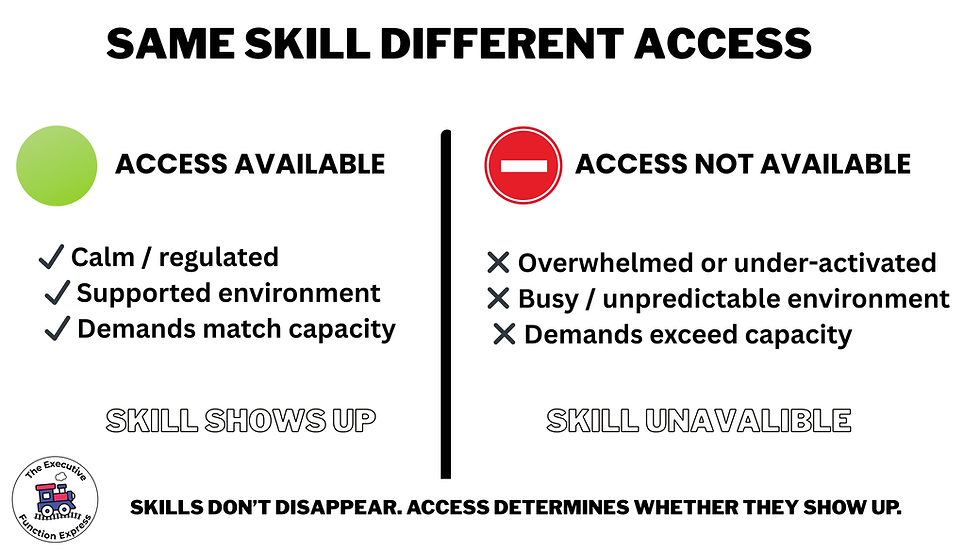
Inhibition is highly sensitive to context. A structured, supportive classroom with clear rules and emotional safety helps children manage their impulses. On the other hand, noisy, chaotic, or unpredictable environments make inhibition much harder, especially for children with EF deficits.
Some children may appear to “hold it together” at school but fall apart at home. This is called masking, not manipulation, but exhaustion from suppressing impulses in a high-demand context. Recognizing this helps adults respond with empathy rather than punishment.
🛠️ How We Can Support Inhibition
To build stronger inhibition skills in children, we must go beyond behavior charts and external rewards. Instead, we can:
Model self-regulation and talk through our own thought process
Play games that build impulse control (like Red Light, Green Light or Simon Says)
Teach emotional awareness, so children recognize the signals that precede impulsive behavior
Use visual supports and consistent routines to reduce uncertainty
Create low-stress environments that allow children to practice inhibition without fear of failure
The Executive Function Express Program Offers checklists to determine if inhibition is causing issues and a long list of evidence-based ways to help children to build this critical skill.

🌱 Final Thoughts
Inhibition is more than just “not blurting out” or “keeping hands to yourself.” It’s a foundational executive function that allows children to access higher-level thinking, build relationships, and engage in learning.
When we understand the brain behind the behavior, we can create environments that don’t just expect inhibition, but actively nurture its growth.
📘 Want to Go Deeper?
If you’re ready to support children with the strategies they actually need to build inhibition and other executive function skills, my book is your essential next step.
Inside, you’ll get:
✅ A clear breakdown of what inhibition really is (and what it’s not)
✅ Simple ways to assess inhibitory control across environments
✅ Tools, games, and real-life strategies to help children regulate impulses and thrive
✅ Printable visuals, reflection prompts, and bonus resources for therapists, teachers, and parents
This book was written with professionals like you in mind. It contains practical, research-aligned, and ready to implement ideas based on a child's strengths and recent evidence.
Full steam ahead!

Dr. Cara Koscinski, OTD, MOT, OTR/L, CAS is a seasoned pediatric occupational therapist, certified autism specialist, author of seven books, and founder of the Executive Function Institute. Known for her practical, strengths-based approach to neurodiversity, she specializes in helping children build executive function through sensory-aware, visual, and body-based strategies. Creator of the Executive Function Express program and a frequent speaker at national conferences, Dr. Koscinski brings warmth, clarity, and decades of clinical expertise to every tool she creates.


Comments